
Listen
Talk about your stage of study, your questions and any decisions coming up. A useful conversation starts with what matters to you.
A supportive conversation about interests, choices and the next steps that matter to you.


You may have a clear interest, several possibilities or no idea where to begin. Each is a reasonable starting point. We listen to your experience and help you explore the options in front of you.
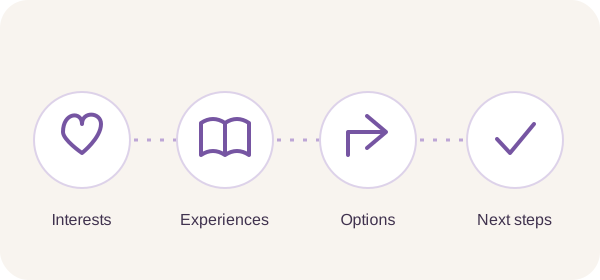
Talk about your stage of study, your questions and any decisions coming up. A useful conversation starts with what matters to you.
Look at subjects, experiences and activities you enjoy. Discuss the difference between an interest, a skill you are building and a route you want to investigate.
Bring relevant background and suitable assessment information into the discussion. Ask what the findings mean and what they cannot tell you.
Choose practical next steps: compare courses, check entry requirements, speak to someone in a field or explore a subject in more depth.
Assessment information is useful only when its purpose and limitations are understood. We consider suitable tools alongside interests, school experiences, performance and personal circumstances.
If DMIT is discussed, ask how it will be used and what evidence supports that use. Fingerprint patterns should not be treated as a reliable prediction of intelligence, ability or the career a student should choose.